
The 5654 Support Index
Download the key findings below:
Trust isn't enough anymore. Corporate Affairs teams must earn support for growth.
It’s not easy to lead and grow a business in today’s volatile world. Stakeholder expectations are rising. Regulation is increasing. Public scrutiny is more intense. And support from the audiences that matter most is becoming harder to earn.
For years our industry has relied on measures of trust and reputation to understand the relationship between organisations and their stakeholders. Those measures remain important, but trust and goodwill alone are no longer enough. They tell us how people feel. But they do not predict action.
Businesses don’t grow simply because their audiences think well of them. They succeed because customers recommend them, employees advocate for them, policymakers listen to them, communities are prepared to support them when it matters and shareholders invest to back them.
That’s why we believe support deserves far greater attention from Corporate Affairs professionals and business leaders than it currently receives.
At 5654 & Company, we've spent the last year exploring what support really means. Not simply as another measure of sentiment, but as the willingness of audiences to actively defend, advocate for and enable the growth of a business or industry.
That thinking led us to create the ‘5654 Support Index’.
We didn't set out to produce another league table of the country’s best and worst-performing sectors. Through in-depth opinion research and analysis, we wanted to understand what drives support, what holds it back, and why some organisations can mobilise support while others struggle to turn this into meaningful action.
We asked over 9,000 people what drives them to support, or oppose, businesses. And our findings, across 15 sectors of the economy, prove sentiment does not always predict action. We also see a more sophisticated picture of support.
We found support begins with delivery, but opposition is more influenced by broader societal and values-based issues. We see that support moves in thresholds – as support strengthens, there are jumps when people become willing to take actions that involve greater effort, or personal reputation risk. And ‘elite’ audiences move faster than the public, to support or opposition, influencing stakeholder decisions and driving public debates.
Some industries enjoy widespread goodwill but mobilise that support in different ways. Hospitality is a good example. It is one of the most supported sectors in Britain, generating exceptionally high levels of positive sentiment. People value the role it plays in local communities and feel positively about restaurants, pubs, hotels and leisure businesses because they are woven into everyday life. Hospitality also records the highest Support Action Score of any sector, showing that people are willing to recommend and publicly endorse it. However, that support weakens as the actions become more demanding. Hospitality inspires warmth, but comparatively less activism than some other sectors.
Other sectors display a different pattern. Defence and Major Infrastructure attract lower levels of overall support than Hospitality – though they are still towards the top of the Support Action table. But, their supporters tend to be more motivated and more willing to sustain higher-effort, higher risk forms of advocacy. These industries are linked to national security, economic growth, jobs and future prosperity. Their supporters may be fewer, but they are often more committed and more willing to act on their beliefs.
The net support score of AI is among the lowest of all industries measured, reflecting concerns about the risks it creates. But look deeper and there are strong reserves of support for AI which are being drowned out today by opposition. Available supporters see AI as a driver of innovation, productivity and future growth. Looking only at positive or negative sentiment misses opportunities to build campaigns that deliver greater support for a technology which is vital for productivity and growth. This is true not just for those companies developing AI, but every company seeking to deploy these technologies, encourage colleagues to adopt them and customers to trust them.
For Corporate Affairs leaders, this is data which can inform smart strategic campaign choices, and better understand when your organisation risks becoming genuinely opposed.
Support should not be understood simply as a measure of popularity. The businesses that succeed are not always those with the highest approval ratings. They are the ones who create supporters prepared to act. And who out-compete those organisations campaigning to build opposition against them, or support in favour of opposing points of view.
In a world where expectations are high and scrutiny intense; businesses need more than trust alone. They need support for growth.
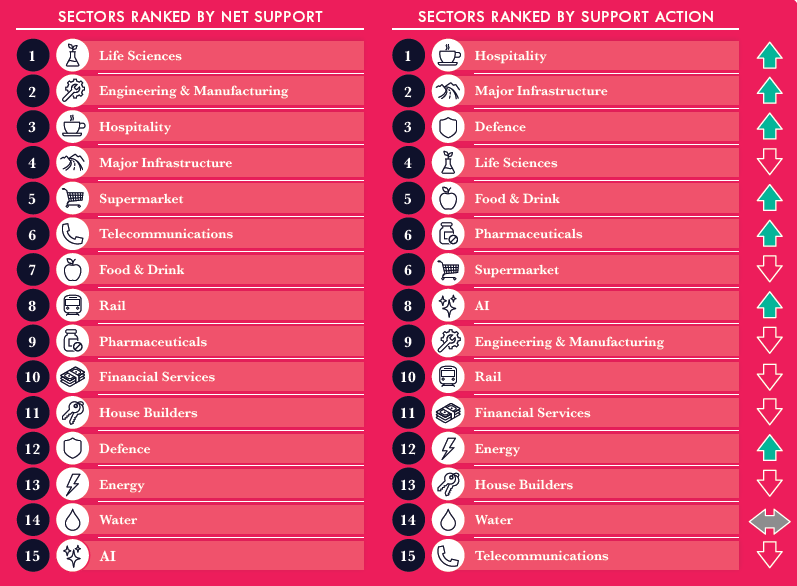
Net Support: Measures overall public opinion towards a sector, combining the levels of support among those who feel positively about it with the level of opposition among those who feel negatively.
Support Action: Measures real-world behaviour, establishing what actions respondents would and would not be willing to take to support a sector, weighted to reflect the effort and risk.